The Regular Dead Bug Too Easy? I’m a Personal Trainer — Here’s How to Progress the Exercise
After practising for a while, can you hold a dead bug position without much effort anymore? Or have you reached a point where the standard dead bug no longer challenges your core like it used to?
As a personal trainer, I will say this is a good sign. Actually, this means your body may have adapted to the exercise, and it’s time to consider a more challenging variation.

Dead bugs are among my favorite core exercises, especially for beginners because they train you how to control your trunk along with moving your arms and legs. And unlike some traditional abdominal exercises, they don’t require repeated spinal bending or twisting.
But here’s the catch: If you want to keep improving your core strength, you eventually need to progress the exercise by breaking through a plateau.
Here are five dead bug variations I’d recommend once the standard version becomes too easy.
🟧 READ MORE
- Can the Dead Bug Exercise Help You Lose Belly Fat? I’m a Personal Trainer — Here’s What It Actually Does
- The Dumbbell Exercise That Challenges Your Entire Core
- This 10-Minute Routine Can Help Strengthen Your Abs and Improve Posture
Why Dead Bugs Are a Good Starting Point for Core Training
When people think about core exercises, popular names like — sit-ups, leg raises, Russian twists, and planks immediately come to mind. These are all useful, but they aren’t equally comfortable or appropriate for everyone.
For exmaple — Sit-ups involve repeated spinal flexion movement, which some people with back discomfort may find difficult. Leg raises can place considerable demands on abdominal control and hip-flexor strength, especially when the legs are lowered too far.
And twisting exercises may aggravate certain back conditions, while planks can be challenging for people who struggle with shoulder discomfort or supporting their body weight.
Age alone doesn’t make these exercises unsafe. Your current strength, mobility, technique, and health history also matter.
This is where dead bugs can be helpful.

You perform them while lying on your back, which provides a stable starting position. You move one limb at a time, adjust your range of motion, and gradually build coordination without supporting your entire body weight.
Here, the goal is to maintain a controlled trunk position while your arms and legs move. This challenges the abdominal muscles and teaches you to resist excessive movement through your lower back.
Dead bugs aren’t automatically better than every other core exercise. But for beginners, older adults who can comfortably get onto the floor, and people rebuilding basic core control, this exercise can be a practical starting point.
5 Dead Bug Variations to Make Your Core Work Harder
Before progressing, make sure you can perform the standard dead bug without your lower back arching excessively, your ribs flaring, or your movements becoming rushed.
If you can’t maintain control, it will be better if you stick with the easier version for now. A more difficult variation doesn’t automatically mean more effective.
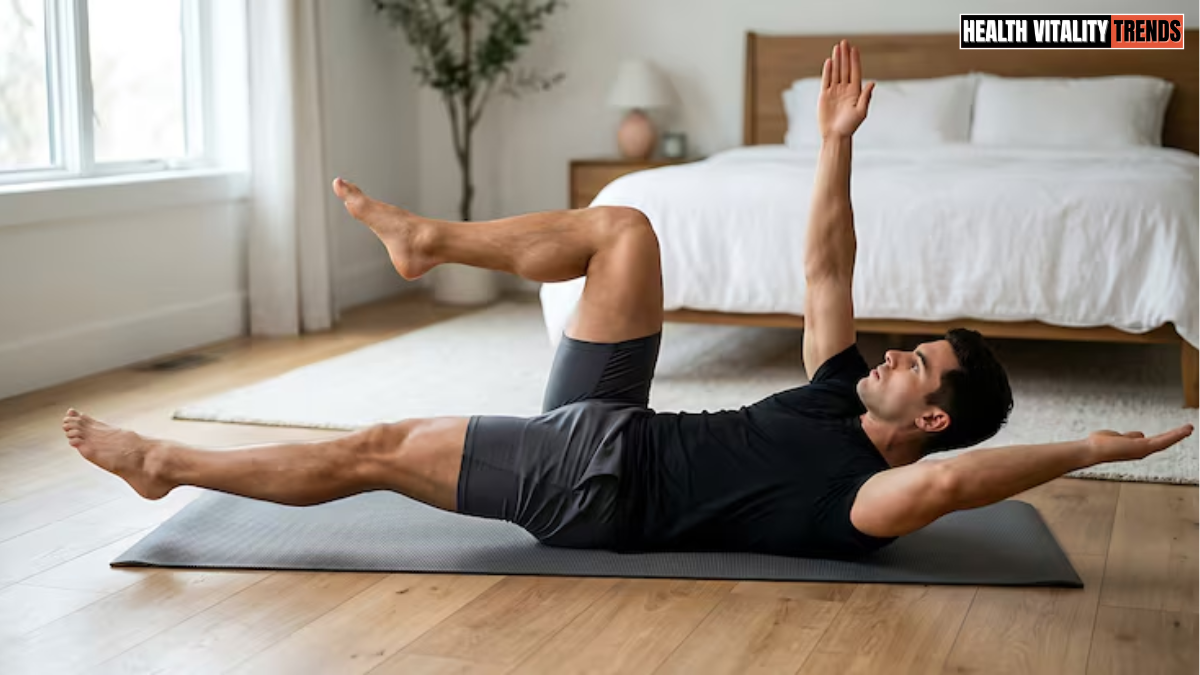
1. Dead Bug With Extended Legs
Best for: Increasing the challenge of controlling your lower back.
This variation increases the lever length by moving your legs farther away from your torso and making your abdominal muscles work harder to control the movement.
How to do it:
- Lie on your back with your arms pointing toward the ceiling and your knees bent at 90 degrees.
- Gently brace your abdominal muscles.
- Slowly extend one leg forward and away from your body without forcing your lower back to arch.
- Bring it back to the starting position.
- Alternate legs for 8 to 10 repetitions per side.
You can start with a partial extension if straightening your leg makes it difficult to maintain control.
2. Dead Bug With Resistance Band
Best for: Adding resistance and improving coordination.
A resistance band introduces an external force that challenges your ability to keep your trunk stable while moving your lower limbs.
How to do it:
- Lie on your back with your knees bent and arms raised.
- Secure a light resistance band overhead using a suitable, stable anchor.
- Hold the band with both hands and gently pull against its resistance.
- Slowly lower one leg while maintaining abdominal tension.
- Return to the starting position and alternate sides for 8–10 repetitions each.
Check the band’s anchor before starting. Use light resistance initially, and don’t allow your ribs to flare as you pull.
And if you’re interested in more practical core-training advice, follow our Facebook page for fitness tips, exercise progressions, and training guidance you can use at home or in the gym.
🟧 READ MORE
- 4 Functional Fitness Exercises That Support Healthy Movement For Life
- Can You Build Muscle With Just Bodyweight Exercises?
- I’m a Personal Trainer — Here’s Why Yoga Can Be Useful Even if You Already Lift Weights
3. Dead Bug With Dumbbell Pullover
Best for: Challenging core stability while the arms move overhead.
This variation combines a controlled leg movement with a dumbbell pullover movement, thus increasing the demand on your abdominal muscles and shoulder control.
How to do it:
- On a mat, lie on your back with your knees bent at 90 degrees.
- Hold a light dumbbell securely with both hands above your chest.
- Brace your core and slowly move the dumbbell backward toward the floor behind your head.
- At the same time, extend one leg away from your body.
- Return both to the starting position, then switch legs.
Perform 6 to 8 repetitions per side. For beginners, start with a very light dumbbell, and stop the arm movement before your lower back begins to arch.
4. Dead Bug With Stability Ball
Best for: Improving coordination and sustained core tension.
The stability ball here is to create contact between your hands and knees. Pressing against it while moving one limb increases the coordination required to maintain your position.
How to do it:
- Lie on your back with your knees raised and bent at 90 degrees.
- Place a stability ball between your hands and thighs.
- Press your hands and thighs gently into the ball.
- Maintain that pressure while slowly extending one leg away from your body.
- Return to the starting position and repeat with the opposite leg.
Try 8 to 10 repetitions per side. The ball should remain steady rather than wobbling around as you move.
5. Weighted Dead Bug
Best for: Progressively increasing the resistance of your core training.
Once you can perform bodyweight variations with consistent control, a small external load can provide another progression.
How to do it:
- Lie on your back with your arms raised and knees bent at 90 degrees.
- Hold a light dumbbell in each hand, keeping the weights directly above your shoulders.
- Brace your abdominal muscles and slowly lower one arm overhead while extending the opposite leg.
- Return to the starting position without letting your lower back arch excessively.
- Alternate sides for 6 to 8 controlled repetitions each.
Use light weights to begin. If you struggle to maintain your position, return to the unweighted version.
How to Progress Without Losing Your Form
You don’t need to perform all five variations in one workout. Choose one that matches your current ability and practice it two or three times per week.
Start with 2 – 3 sets of 6 to 10 controlled repetitions per side, and adjust the volume to your fitness level. Increase resistance when you can complete your repetitions with steady breathing and consistent trunk control.

The Bottom Line
The dead bug isn’t just an exercise for beginners. It’s a movement you can progress as your strength and coordination improve.
Start with the standard version, learn to control your trunk, and gradually introduce longer levers, resistance, or more demanding combinations. You don’t need to rush toward the hardest variation to make progress.
As a personal trainer, my advice is simple: make the exercise harder only when you can perform it well. Quality movement matters more than adding weight or chasing repetitions.
For more short, practical fitness tips and daily training advice, join the Health Vitality Trends WhatsApp community. It’s an easy way to keep learning about core strength, mobility, exercise technique, and healthier habits.
Editor’s Note: This content is for informational and educational purposes only and is not intended to diagnose, treat, or cure any medical condition. Always consult your physician or a qualified personal trainer before starting any workout or nutrition program.