


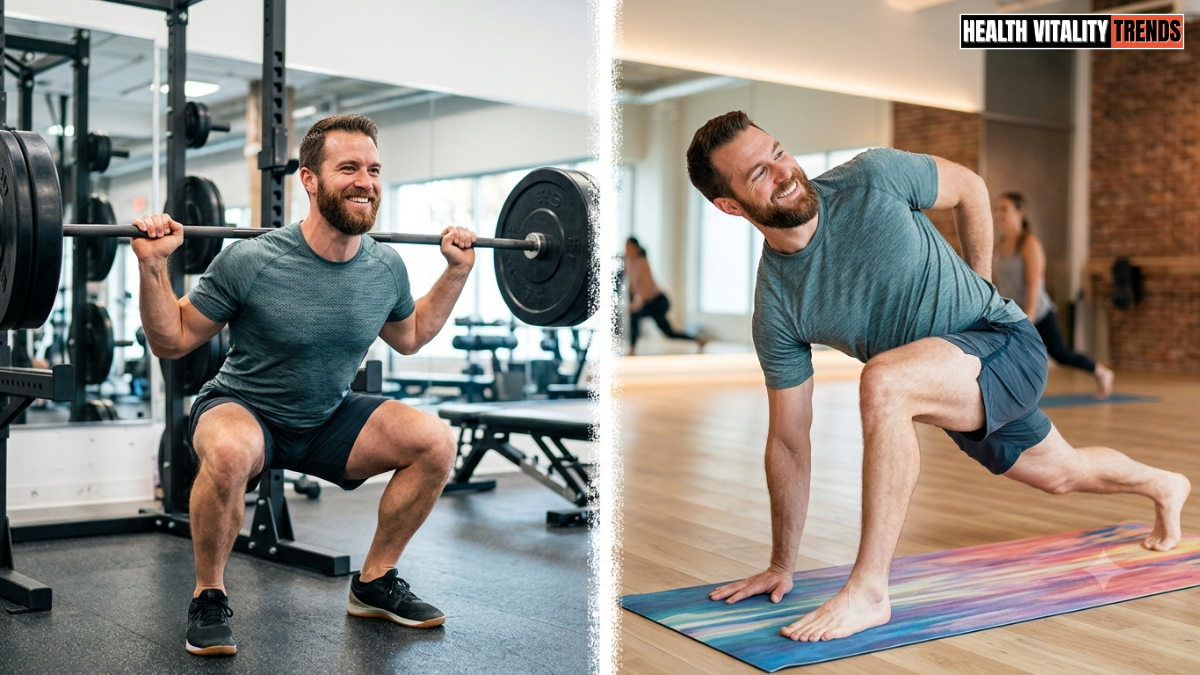
I’m a Personal Trainer — Here’s Why Yoga Can Be Useful Even if You Already Lift Weights
If you spend hours lifting weights, building muscle, and getting stronger in the gym, but still struggle with stiff shoulders, tight hips, or limited mobility — you might be missing an important part of your fitness routine.
As a personal trainer with a decade of experience, I’ve learned that building an impressive physique and building a body that moves well are not necessarily the same thing. Weight training is excellent for developing strength and muscle mass. But what about flexibility, balance, joint mobility, and controlled movement? Ever thought about it?

Probably not, because many gym enthusiasts overlook these areas.
And no, the solution isn’t to stop lifting weights or replace your strength workouts with yoga. It’s to combine the two.
Yoga can complement weight training by improving flexibility, helping you practice controlled movement, and addressing some mobility limitations that may interfere with exercise technique. Here are 10 yoga poses I’d recommend to weightlifters and bodybuilders who want to start moving better without sacrificing their hard-earned gains.
🟧 READ MORE
- Want a Better Warm-Up Before Strength Training? I’m a Personal Trainer — Try These Yoga-Inspired Moves
- Can You Build Muscle With Just Bodyweight Exercises?
- 4 Functional Fitness Exercises That Support Healthy Movement For Life
Why Weightlifters Should Pay More Attention to Yoga
Modern fitness culture has encouraged more people to take strength training seriously. That’s a positive development. More people are joining gyms, paying attention to nutrition, and working toward stronger, healthier bodies.
But there’s a catch.
Many recreational lifters concentrate almost entirely on muscle growth, strength, and lifting heavier weights. Flexibility and balance often become afterthoughts.
Over time, repeatedly training through similar movement patterns without enough attention to mobility can leave you feeling stiff. Long periods of sitting, limited movement outside the gym, and inadequate recovery can contribute to the problem, too.

For example — someone who spends most of their training time bench-pressing may neglect the mobility and movement control needed for comfortable overhead movements. Another lifter might develop difficulty reaching a comfortable squat depth because of individual mobility limitations, technique, or body proportions.
Weight training itself doesn’t automatically make you inflexible. Strength training performed through an appropriate range of motion can also improve flexibility. The problem is assuming that strength is the only quality worth developing.
Restricted movement can make certain exercises feel uncomfortable, complicate technique, and limit the positions you can comfortably achieve. It may also make everyday activities, such as reaching overhead or bending down, feel less natural.
That’s where yoga can help you.
How Yoga Complements Strength Training
I understand why some serious lifters dismiss yoga as something reserved for relaxation or meditation. But yoga involves much more than sitting quietly and breathing.
Depending on the poses you practice, it can challenge your flexibility, balance, core control, and ability to coordinate movement with breathing.

Here’s why those benefits matter to weightlifters.
- Better flexibility: Regular yoga practice can improve your ability to move through a comfortable range of motion. This may help with exercises such as squats, lunges, and overhead presses.
- Improved mobility and movement control: Yoga encourages you to explore positions slowly rather than relying entirely on momentum or external resistance.
- More balanced training: Gentle stretches can help address areas that feel tight after repetitive training, particularly around the hips, chest, shoulders, and back.
- Better core stability and balance: Many poses require you to control your trunk and maintain alignment while moving your limbs.
- Controlled breathing and body awareness: Coordinating movement with breathing can help you become more aware of tension and improve your ability to stay composed during challenging exercises.
Yoga may also support recovery by providing a lower-intensity movement session between demanding workouts. However, it isn’t a shortcut to muscle recovery, and it cannot compensate for inadequate sleep, nutrition, or excessive training volume.
And here’s something worth remembering — you don’t have to choose between looking strong and moving well. A well-rounded fitness routine can help you work toward both.
If you enjoy practical advice from a trainer’s perspective, follow our Facebook page for more strength-training, mobility, and fitness tips you can apply to your own routine.
10 Yoga Poses I’d Recommend to Stiff Weightlifters
I will say it again — You don’t need to immediately master complicated yoga sequences on your first attempt. Start with comfortable positions, move slowly, and avoid forcing your body into a stretch.
The following 10 poses can form a beginner-friendly session lasting approximately 15 to 30 minutes. Use the suggested durations as a guide rather than a strict requirement.
1. Child’s Pose (Balasana)
Helps with: Gentle relaxation of the back, hips, and shoulders. This is the simplest yoga pose you can do after a demanding training session.
How to do it:
- Kneel on the floor with your big toes touching and knees comfortably apart.
- Slowly sit your hips back toward your heels.
- Extend your arms forward and lower your chest toward the floor as comfortably as possible.
- Breathe slowly and hold for 30 to 60 seconds.
If your hips don’t comfortably reach your heels, place a cushion between your thighs and calves.
2. Cat-Cow Stretch (Marjaryasana-Bitilasana)
Helps with: Spinal mobility and awareness of movement through the back.
Lifters who spend long periods sitting or repeatedly brace their trunks during heavy lifts may appreciate this gentle movement.
How to do it:
- Start on your hands and knees, with your hands beneath your shoulders.
- Inhale as you gently arch your back and lift your chest and tailbone.
- Exhale as you round your spine and gently draw your chin toward your chest.
- Repeat slowly for 8 to 12 cycles.
Move through a comfortable range rather than forcing an exaggerated arch or rounding your back.
3. Downward-Facing Dog With Bent Knees (Adho Mukha Svanasana)
Helps with: Shoulder mobility and gentle stretching through the calves and back of the legs. This variation is useful for beginners who find the traditional pose too demanding.
How to do it:
- Begin on your hands and knees.
- Tuck your toes and lift your hips upward and backward.
- Keep your knees bent and press your hands gently into the floor.
- Lengthen your spine while keeping your neck relaxed.
- Hold for 20 to 40 seconds while breathing comfortably.
Don’t force your heels toward the floor. A long, comfortable spine matters more than straight legs.
4. Sphinx Pose (Salamba Bhujangasana)
Helps with: Gentle spinal extension and comfortable chest opening.
If your upper body spends much of the day rounded over a desk, this pose offers an opportunity to practice a different position.
How to do it:
- Lie on your stomach with your legs extended behind you.
- Place your elbows beneath or slightly ahead of your shoulders.
- Gently lift your chest by pressing your forearms into the floor.
- Keep your shoulders relaxed and your neck neutral.
- Hold for 20 to 40 seconds.
Avoid pushing into your lower back. Come out of the pose if you experience pain, tingling, or discomfort.
5. Low Lunge (Anjaneyasana)
Helps with: Hip-flexor flexibility, particularly for people who sit for long periods.
Tightness around the front of the hips can make some lunging and hip-extension movements feel restricted.
How to do it:
- Start in a kneeling position and step one foot forward.
- Keep the front foot flat, with the knee generally aligned over the ankle.
- Lower the back knee onto a folded mat or cushion.
- Gently shift your hips forward until you feel a mild stretch at the front of the back hip.
- Hold for 20 to 30 seconds, then switch sides.
Keep your torso upright if comfortable. Don’t force your hips forward or arch your lower back excessively.
🟧 READ MORE
- Why Some People Build Muscle Faster Than Others
- I’m a Personal Trainer — Try These 5 Yoga Poses When Your Upper Back Feels Tight
- This 10-Minute Routine Can Help Strengthen Your Abs and Improve Posture
6. Bound Angle Pose (Baddha Konasana)
Helps with: Gentle stretching of the inner thighs and hips. This seated pose introduces lifters to a comfortable hip-opening position without requiring advanced flexibility.
How to do it:
- Sit on the floor with your legs extended.
- Bring the soles of your feet together and allow your knees to move outward.
- Hold your feet or ankles without pulling forcefully.
- Sit tall and let your knees lower naturally.
- Hold for 30 to 45 seconds.
If your knees sit high or your back rounds, sit on a folded blanket. Never press your knees down with your hands.
7. Half Pigeon Pose With Support (Eka Pada Rajakapotasana Variation)
Helps with: Gentle stretching around the outer hip and gluteal region.
Squats, lunges, and other lower-body exercises challenge the hips in different ways. This pose offers another position in which to explore comfortable hip movement.
How to do it:
- Start on your hands and knees.
- Bring one knee forward toward the same-side wrist.
- Angle the shin comfortably in front of you, keeping the foot closer to the pelvis if needed.
- Extend the opposite leg behind you.
- Place a cushion beneath the front hip if it doesn’t reach the floor.
- Remain upright or lean forward slightly, holding for 20 to 30 seconds per side.
Don’t force the front shin to become parallel with the front edge of your mat. If you experience knee pain, stop and choose a gentler alternative, such as lying on your back and crossing one ankle over the opposite thigh.
8. Reclined Hand-to-Big-Toe Pose (Supta Padangusthasana)
Helps with: Hamstring flexibility without requiring you to balance while standing. This is a useful option for lifters who struggle with tight hamstrings or find standing stretches uncomfortable.
How to do it:
- Lie on your back with both legs extended.
- Lift one leg toward the ceiling while keeping the other leg relaxed on the floor.
- Hold behind the thigh or calf, or use a yoga strap around your foot.
- Keep the raised knee slightly bent if necessary.
- Hold for 20–30 seconds, then switch legs.
Keep your lower back comfortable and avoid pulling your leg toward you aggressively.
9. Thread the Needle (Parsva Balasana)
Helps with: Gentle rotation through the upper back and stretching around the back of the shoulder.
This can be particularly useful for people who want to explore upper-back movement after repetitive pressing exercises.
How to do it:
- Begin on your hands and knees.
- Slide your right arm underneath your left arm, turning your chest gently.
- Lower your right shoulder and the side of your head toward the mat if comfortable.
- Keep your hips relatively steady.
- Hold for 20–30 seconds, then repeat on the opposite side.
Avoid forcing the twist or placing excessive weight on your shoulder.
10. Reclined Spinal Twist (Supta Matsyendrasana)
Helps with: Gentle rotational movement through the trunk and relaxation after training. Finish your session with a movement that allows you to slow down and breathe.
How to do it:
- Lie on your back with your knees bent.
- Extend your arms out to the sides.
- Slowly lower both knees toward one side while keeping your shoulders comfortably supported.
- Turn your head in the opposite direction only if that feels natural.
- Hold for 20–30 seconds, then switch sides.
Let gravity assist the movement. You don’t need to push your knees all the way to the floor.
How to Fit Yoga Into Your Weight-Training Routine
Frankly, you don’t need to add an extra hour of yoga to an already busy schedule.
You can start with 15 minutes, two or three times per week. Choose four or five poses that address the areas where you feel most restricted, then gradually introduce the others.
A short session after lifting or on a lighter training day can work well. Before heavy lifting, prioritize a dynamic warm-up and exercise-specific preparation rather than relying on long, passive stretches immediately before maximal efforts.

Most importantly, treat yoga as a complement to progressive strength training, not a replacement for it. You still need appropriate resistance, training volume, nutrition, and recovery to build muscle.
And remember that more stretching isn’t always better. If a position causes sharp pain, numbness, tingling, or joint discomfort, stop and seek appropriate professional guidance if symptoms persist.
The Bottom Line: Strong Muscles Are Only Part of the Picture
As a personal trainer, I’d never tell someone to abandon weightlifting in favor of yoga. Strength training remains one of the most valuable tools for building muscle, improving strength, and supporting long-term physical function.
But I also wouldn’t encourage anyone to ignore mobility, balance, flexibility, and movement control simply because these qualities don’t always receive the same attention as bigger arms or a heavier bench press.
Your goal shouldn’t be to lift more weight at any cost. It should be to build a body that is strong, capable, and comfortable moving through everyday life.
Yoga can help you work toward that goal. Start with a few beginner-friendly poses, practice consistently, and pay attention to how your body responds.
And if you’re looking for short, practical fitness tips and training advice you can use every day, join the Health Vitality Trends WhatsApp community. It’s a simple way to keep learning about strength training, mobility, nutrition, and healthier habits without having to figure everything out alone.
Editor’s Note: This content is for informational and educational purposes only and is not intended to diagnose, treat, or cure any medical condition. Always consult your physician or a qualified personal trainer before starting any workout or nutrition program.





1 Comment