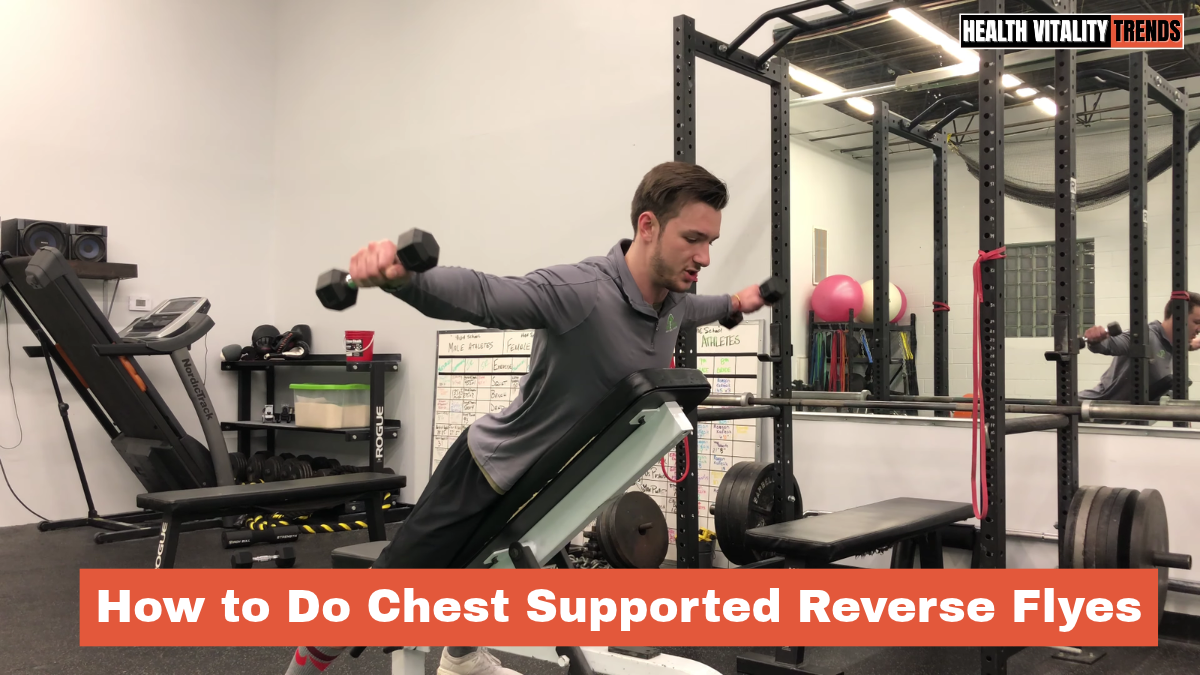
How to Do Chest-Supported Reverse Flyes: Bulletproof Your Rear Delts Without Cheating
Build stronger, more defined rear delts with controlled dumbbell movements that eliminate momentum and put your posterior shoulders to work.
Your rear delts aren’t growing despite all those Rows and Face Pulls? The problem might not be your training volume. It could be how you’re performing your exercises.
The Chest-Supported Reverse Fly is one of my favourite ways to isolate the posterior deltoids without allowing excessive body movement to take over. All you need is an incline bench and a pair of dumbbells.
Unlike Standing Reverse Flyes, where people often use their lower back, hips, and momentum to move the weights, the chest-supported variation keeps your torso supported throughout the exercise. This makes it easier to concentrate on the actual shoulder movement.

As a personal trainer, I like this exercise because it’s straightforward, requires minimal equipment, and teaches beginners how to understand and control their rear delts.
I also prefer it over the Reverse Pec Deck Fly on certain shoulder-training days. And when performed correctly, it can be an excellent addition to a well-rounded shoulder routine.
Let’s break it down.
🟧 READ MORE
- How to Do Cable Face Pulls: The Non-Negotiable Exercise for Posture and Shoulder Health
- How to Do Reverse Pec Deck Fly: The Ultimate Hypertrophy Hack for Stubborn Rear Delts
Muscles Worked During Chest-Supported Reverse Flyes
Primary muscle: Posterior deltoid
The posterior deltoid, commonly called the rear delt, is the primary muscle responsible for producing shoulder horizontal abduction during this exercise.
In simple terms, it helps move your upper arms outward and backward, away from the front of your body. It also contributes to shoulder extension and external rotation, depending on arm position.
The Chest-Supported Reverse Fly places particular emphasis on horizontal abduction, making it an effective isolation exercise for developing the rear shoulder.
Supporting and stabilizing muscles
Although the posterior deltoid does most of the targeted work, several other muscles contribute to the movement:
- Middle trapezius and rhomboids: Assist with scapular retraction, bringing the shoulder blades toward each other.
- Rotator cuff muscles: Help stabilize the shoulder joint and maintain control of the upper arm.
- Trapezius: Helps stabilize and control the shoulder girdle.
- Forearm and grip muscles: Maintain a secure hold on the dumbbells.
The goal isn’t to turn this into a rowing exercise. You want the rear delts to perform the majority of the shoulder movement rather than relying excessively on squeezing your shoulder blades together.
1. The Setup
Set an adjustable bench at approximately 30 – 45 degrees. Lie face down with your chest supported against the inclined pad.
Keep your feet firmly planted on the floor for stability. Hold a dumbbell in each hand, allowing your arms to hang naturally toward the floor.
Maintain a slight bend in your elbows. Your palms can face each other in a neutral grip.
Keep your neck relaxed and your spine in a neutral position.
2. Initiate the Movement
Begin by raising both arms outward, away from your body.
Think about moving your elbows outward rather than simply lifting the dumbbells with your hands. This helps you understand the horizontal abduction movement performed by the posterior deltoids.
Maintain the same slight elbow bend throughout the repetition.
Avoid shrugging your shoulders or using momentum to initiate the lift.
3. The Peak Contraction
Continue raising your arms until your upper arms are approximately in line with your torso, or slightly below it if your shoulder mobility requires it.
Pause briefly and consciously contract your rear delts.
You don’t need to forcefully squeeze your shoulder blades together. Excessive scapular retraction can turn the movement into more of an upper-back exercise.
Keep your shoulders away from your ears and maintain control.
4. The Controlled Return
Slowly lower the dumbbells toward the starting position.
Don’t allow gravity to pull your arms down uncontrollably. Maintain tension throughout the eccentric phase, which is the lowering portion of the repetition.
Allow your shoulder blades to move naturally as your arms return.
That’s one complete repetition.
🟧 READ MORE
- Why We Only Train Muscles We Can See in the Mirror — And How to Fix It
- I Traded The Leg Press For Unilateral Movements — My Knees Have Never Felt Better.
Common Chest-Supported Reverse Fly Mistakes to Avoid
The biggest mistake I see with rear-delt training is using too much weight.
Unlike compound shoulder exercises such as overhead presses, reverse flyes are designed to isolate a relatively small muscle group. You don’t need to impress anyone with the dumbbell weight.
Here are four mistakes worth avoiding.
1. Lifting Too Heavy
Your posterior deltoids already contribute to several pulling movements, particularly rows and other back exercises.
When you perform reverse flyes, the objective is to provide additional targeted stimulus rather than simply move heavy dumbbells.
If you cannot raise the weights without shrugging, swinging, or excessively retracting your shoulder blades, reduce the resistance.
2. Using Your Shoulder Blades Instead of Your Rear Delts
This is particularly common among people who are new to shoulder isolation exercises.
They pull their shoulder blades together aggressively, allowing the middle trapezius and rhomboids to dominate the movement.
Instead, concentrate on moving your upper arms outward while maintaining controlled shoulder-blade movement.
3. Locking or Over-Bending Your Elbows
Keep a slight, comfortable bend in your elbows throughout the exercise.
Completely straightening your arms increases the lever length and can make the exercise unnecessarily difficult. Excessive elbow bending, on the other hand, can turn the movement into something resembling a row.
Find a comfortable position and maintain it throughout each repetition.
4. Raising the Dumbbells Too High
You don’t need to lift your arms excessively high or force your hands above shoulder level.
Raise your upper arms approximately to torso level, provided your shoulders remain comfortable.
Excessive range of motion can encourage compensation through the shoulder blades and upper trapezius.
Sets, Reps, and Training Tips
For most people, I recommend starting with:
- Sets: 3 or 4
- Repetitions: 12 to 20
- Rest: 45 to 90 seconds
- Weight: Light to moderate resistance
A pair of 5 – 20 lb dumbbells can be a useful starting reference, but the appropriate weight depends on your strength and training experience. Beginners should start lighter and prioritize movement quality.
My biggest recommendation is to master the contraction before increasing resistance.
You should be able to complete every repetition without swinging your body, shrugging your shoulders, or turning the movement into a row.
And remember, you don’t have to train rear delts exclusively with high repetitions. They can respond to different repetition ranges, provided you use appropriate resistance, sufficient effort, and progressive overload.
Why Everyone Should Train Their Rear Delts
When people train shoulders, their attention usually goes toward the anterior and lateral deltoids.
The front delts receive considerable stimulation from pressing movements, while lateral raises directly target the middle delts.
But the posterior deltoids deserve equal attention in a balanced shoulder-training program.
Well-developed rear delts contribute to the rounded appearance of the shoulders when viewed from the side and back. They also assist with several pulling movements and help maintain balanced shoulder musculature.
If you spend considerable time sitting, working at a desk, or performing pressing exercises, strengthening your posterior shoulder muscles can also be a useful part of a broader shoulder-training routine.
However, don’t mistake rear-delt training for a complete posture correction program. Shoulder positioning also depends on mobility, strength, motor control, and individual movement habits.
Want more practical exercise breakdowns and personal-training insights? Follow our Facebook page for straightforward fitness advice, training techniques, and workout guidance.
🟧 READ MORE
- Dead Bug vs. Plank: Here Is the Exact Core Exercise a Personal Trainer Recommends Above All Else
- Here’s a Simple Yoga Routine for Beginners Who Want Better Balance After 50
Alternative Exercises for Rear Delts
The Chest-Supported Reverse Fly isn’t the only way to train your posterior deltoids. Depending on your equipment, experience, and training preferences, you can use several alternatives.
Machine Exercises
- Rear Delt / Row Machine: Provides a supported movement pattern and allows you to adjust the resistance easily. (Check Exercise Here)
- Reverse Pec Deck Fly: Uses a fixed movement path to target shoulder horizontal abduction. (Check Exercise Here)
Dumbbell Exercises
- Standing Bent-Over Reverse Fly: A free-weight variation that requires greater torso and trunk stabilization.
- Seated Reverse Lateral Raise: Allows you to perform the reverse fly movement while seated and reduces the need to maintain a standing hip hinge.
Cable Exercises
- Cable Face Pull: Combines shoulder horizontal abduction with external rotation, depending on your technique. (Check Exercise Here)
- Reverse Cable Crossover: Provides resistance throughout a wider portion of the movement.
- Bent-Over Cable Rear Delt Raise: Uses a bent-over position to target the posterior deltoids with cable resistance.

Final Thoughts
The Chest-Supported Reverse Fly is a simple but highly useful exercise for developing your posterior deltoids.
You don’t need heavy dumbbells, complicated equipment, or excessive repetitions to get results. Focus on controlled shoulder movement, maintain a consistent elbow position, and let your rear delts do the work.
As a personal trainer, I’d rather see someone perform 15 technically sound repetitions with lighter dumbbells than struggle through eight repetitions with weights that are too heavy.
Train with control. Build strength progressively. And don’t neglect the rear shoulder just because you can’t see it in the mirror.
Want short daily fitness tips and practical training advice? Join our Health Vitality Trends WhatsApp community and make smarter decisions about your workouts, strength training, nutrition, and overall fitness.
Editor’s Note: This content is for informational and educational purposes only and is not intended to diagnose, treat, or cure any medical condition. Always consult your physician or a qualified personal trainer before starting any workout or nutrition program.