I Traded The Leg Press For Unilateral Movements — My Knees Have Never Felt Better.
I ditched ego-driven leg presses for unilateral training to build stronger quads, correct imbalances, and improve knee function.
Let me be honest. When I first started lifting, upper-body training was my favorite part of the gym. Chest, shoulders, arms, and back? I could train them without much convincing. But leg day was an entirely different story.
I was one of those lifters who occasionally found excuses to avoid training legs properly. Heavy squats felt exhausting, and the leg press became my favorite shortcut to getting through a lower-body workout.

But things changed when I became a personal trainer.
I started understanding how the quadriceps, hamstrings, glutes, and surrounding connective tissues work together to produce force, stabilize the knee, and control movement. I also began questioning whether chasing heavier numbers on the leg press was actually making my lower body stronger in the way I wanted.
Eventually, I started replacing much of my traditional bilateral leg-press training with unilateral movements.
The difference was noticeable. I could identify strength discrepancies more easily, develop better control through each leg, and train my quads without constantly chasing heavier loads.
“And that’s when I realized something important — Building stronger legs isn’t about how much weight you can push with both feet. It’s about how well each leg can independently produce and control force.”
🟧 READ MORE
- Swap Your Heavy Squats for This Single Step-Up Variation to Transform Your Stability
- I Realized My Right Leg Was Doing All The Work — So I Fixed It
The Leg Press Paradox: Why I Stopped Chasing Bigger Numbers
I don’t hate the leg press. In fact, I still consider it a useful piece of gym equipment. But I think many lifters misunderstand what this machine can and cannot do.
The leg press is almost like a cheat code for lower-body training. You sit down, position your feet, load the machine, and push. There’s no barbell balancing across your back, no complicated setup, and considerably less demand on your upper-body stabilization.
For beginners, that’s a genuine advantage.
It allows you to learn how to recruit your quadriceps, glutes, and hamstrings while developing basic lower-body strength. It’s also useful for experienced lifters who want to accumulate additional volume without having to perform every set with a barbell on their back.
But there’s another side to this convenience.
How The Leg Press Can Hide Strength Imbalances
Here’s the problem I started noticing.
When you perform a conventional bilateral leg press, both legs work together to move the platform. Ideally, each leg should contribute an appropriate amount of force.
But what happens when your right leg is considerably stronger than your left?
Your dominant side may unconsciously contribute more force. You might shift your pressure toward one foot, subtly rotate your hips, or allow one side to complete more of the work.
The machine doesn’t necessarily expose these differences.
You can finish a set, look at the weight stack, and feel proud of pushing 300 or 400 pounds without realizing that your stronger leg has been doing a disproportionate share of the work.
That’s why I don’t consider impressive leg-press numbers proof of balanced lower-body strength.
Unilateral training provides a better opportunity to assess each leg independently. You can identify differences in strength, stability, coordination, and muscular endurance instead of allowing both sides to hide behind one combined performance.
🟧 READ MORE
- Your Tight Lower Back Isn’t The Problem — Your Locked Hips Are
- Why Looking Jacked Won’t Save You: The Bodyweight Moves That Build True Survival Strength.
The Problem With Ego-Lifting On The Leg Press
I’ve seen plenty of lifters load the leg press with more weight than they can comfortably control.
They lower the platform only a few inches, bounce out of the bottom position, and push aggressively until their knees approach lockout.
That’s not impressive lower-body development. It’s poor load management.
The knee joint experiences substantial forces during loaded knee flexion and extension. The patellofemoral joint, where the kneecap articulates with the thigh bone, is particularly sensitive to changes in loading demands.
As knee flexion increases under resistance, patellofemoral loading can increase as well. That doesn’t make deep leg presses inherently dangerous, but it does mean that excessive loading, poor control, unsuitable range of motion, and individual tolerance matter.
I also want to clear up one common misconception — Knee wraps aren’t a requirement for safe leg pressing. They may provide compression and a different lifting sensation, but they cannot compensate for excessive loading or poor technique.
If you’re experiencing grinding sensations, persistent pain behind the kneecap, or discomfort when pushing through repetitions, don’t simply wrap your knees tighter and continue.
Reduce the load, reassess your technique, and seek professional assessment if symptoms persist.

So, Is The Leg Press Completely Useless?
Absolutely not.
I still like using it for controlled, higher-repetition sets, particularly in the 15 to 20 rep range, when I want additional quadriceps training volume.
It’s also useful when beginners need a stable environment to develop lower-body strength without immediately managing the technical demands of free-weight exercises.
The mistake is treating the leg press as the foundation of every lower-body program or assuming that heavier numbers automatically translate into better functional strength.
I wanted something different from my training.
I wanted each leg to become stronger independently, my movement patterns to become more controlled, and my knees to tolerate training without unnecessary irritation.
That brought me to unilateral movements.
Why I Started Prioritizing Unilateral Training For My Knees
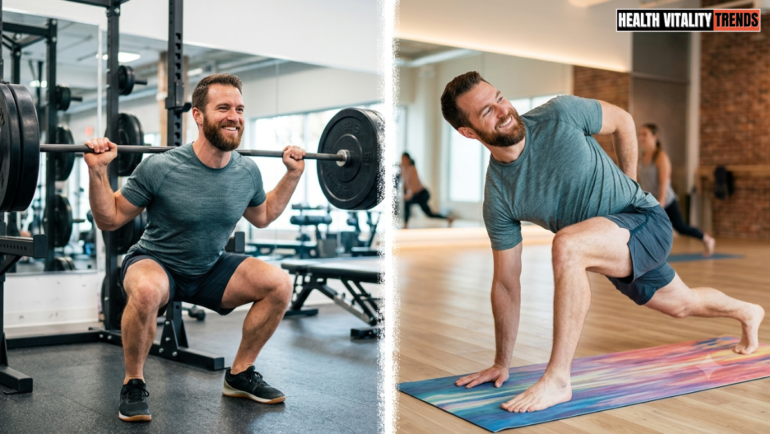
Unilateral training means performing an exercise using one leg at a time rather than relying on both legs simultaneously.
Think walking lunges, Bulgarian split squats, single-leg presses, and step-ups.
What makes these exercises valuable is that each leg must independently produce force while controlling the movement.
Your quadriceps generate knee-extension force, your glutes help control hip movement, and your surrounding muscles contribute to stability.
You also have to manage balance and coordination.
This doesn’t mean unilateral exercises automatically produce less knee stress or guarantee pain-free knees. A poorly performed pistol squat can be considerably more demanding than a properly executed leg press.
The real advantage is control over how each limb works and how much resistance you apply.
I could reduce the workload, adjust the range of motion, and identify which side needed more attention.
The research supports this distinction. A 2025 systematic review and meta-analysis published in Sports Medicine found that unilateral and bilateral resistance training produced comparable muscle hypertrophy, while their strength benefits were more specific to the type of training performed. Unilateral training favored unilateral strength development, while bilateral training favored bilateral strength.
In other words, you don’t have to abandon muscle growth to prioritize independent leg development.
And if you enjoy practical lessons like these, follow our Facebook page for more personal-trainer insights, exercise breakdowns, and strength-training strategies you can actually use in the gym.
🟧 READ MORE
- If Your Hips Always Feel Tight, Try Adding These Game-Changing Stretches To Your Routine
- These 6 Beginner-Friendly Yoga Poses Melt Away Lower Back Tension and Tight Hips in Minutes
5 Unilateral Exercises I Prioritize For Stronger Quads And Better Knee Control
These are five movements I particularly like because they allow you to train each leg independently while developing strength, coordination, and control.
The key is to select a resistance and range of motion you can manage without compensating or forcing your knees into uncomfortable positions.
1. Weighted Walking Lunges
Old-school walking lunges remain one of my favorite lower-body exercises.
Hold a pair of dumbbells at your sides, step forward with one leg, and lower your body under control until both knees are comfortably bent. Push through the front foot to bring your body forward, then repeat with the opposite leg.
What I particularly like about walking lunges is that they challenge more than quadriceps strength.
Your glutes, hamstrings, and hip stabilizers must contribute to controlling each step. Your knees also have to manage the forces generated during forward movement.
Keep your torso controlled, avoid allowing your front knee to collapse inward, and don’t take excessively long steps just to make the exercise harder.
2. Bulgarian Split Squats
If I had to choose one unilateral exercise for serious quadriceps development, Bulgarian split squats would be near the top of my list.
Place your rear foot on a bench behind you and position your front foot far enough forward to maintain a stable base. Lower your hips under control, allowing your front knee to travel naturally as you descend.
Drive through the front foot to return to the starting position.
The exercise challenges your quadriceps and glutes while requiring considerable hip and knee coordination.
Another advantage is that you can train your legs without placing a heavy barbell across your upper back. That doesn’t eliminate spinal loading, but it can reduce the need for heavy axial loading compared with conventional barbell squats.
Don’t chase extreme depth immediately. Work within a comfortable range, maintain balance, and gradually increase resistance.
3. High-Step Step-Ups With A Slow Descent
Step-ups are often underestimated because they look relatively simple.
But when you increase the step height appropriately and control the lowering phase, they become a demanding unilateral strength exercise.
Stand in front of a stable elevated platform, place one foot firmly on it, and drive through that working leg to bring your body upward.
Once you’re standing, slowly lower yourself back down, controlling the descent rather than dropping onto the opposite foot.
That lowering phase is particularly important.
Your quadriceps must work eccentrically to control knee flexion while your glutes and other stabilizing muscles help maintain alignment.
Progressive resistance training can improve muscle strength and tendon capacity over time. However, don’t assume that slow step-downs automatically make your tendons injury-proof.
Start with a height that allows you to maintain control. If your knee collapses inward or your pelvis drops significantly, reduce the height.
4. Pistol Squats
Pistol squats are among the most demanding bodyweight movements you can perform for unilateral lower-body strength.
You stand on one leg, extend the opposite leg in front of you, and lower your body into a deep single-leg squat before returning to standing.
Sounds simple?
Try performing five controlled repetitions on each side.
You’ll quickly discover how much strength, mobility, balance, and coordination this exercise demands.
Your quadriceps must generate substantial force to control the descent and drive you upward. Your glutes and hip stabilizers also work hard to keep your body aligned.
But here’s my advice — Don’t rush into full pistol squats just because you see experienced lifters performing them.
Start with assisted variations, holding a stable support or using a box to limit your depth. Build the necessary strength and control before attempting the complete movement.
Pistol squats are a strength test, not a mandatory knee-health exercise.
🟧 READ MORE
- 10 Yoga Poses to Add to Your Warm-Up for Better Lunges and Squats
- 4 Functional Fitness Exercises That Support Healthy Movement For Life
5. Single-Leg Leg Press
I know. I said I traded the leg press for unilateral movements.
But there’s an important distinction here.
A single-leg leg press allows you to retain the stability and adjustable resistance of the machine while training each leg independently.
Instead of placing both feet on the platform, position one foot securely and perform the movement using that leg alone.
Lower the platform slowly, maintain your hips against the seat, and press back up without aggressively locking your knee.
Start with a considerably lighter resistance than your conventional bilateral working weight.
This is particularly useful for identifying strength differences because you can record exactly how much resistance each leg handles independently.
And unlike conventional leg pressing, your stronger leg cannot directly assist your weaker leg in moving the platform.
The goal isn’t to push the heaviest possible weight. It’s to make both legs perform their share of the work.

The Biggest Lesson: Don’t Ignore What Your Knees Are Telling You
Looking back, changing my approach to leg training taught me something that I wish I had understood much earlier.
You don’t need to keep adding plates to the leg press to prove that your legs are getting stronger.
Sometimes, the better decision is to reduce the weight, train each side independently, and pay closer attention to how your body moves.
If you notice that one leg is significantly stronger, one knee consistently feels uncomfortable, or your movement becomes unstable under heavier loads, don’t ignore those signs.
Start by reviewing your exercise technique, resistance, range of motion, and training volume. Introduce unilateral exercises gradually, prioritize controlled repetitions, and give your body sufficient recovery.
And if knee pain persists, worsens, or interferes with everyday movement, consult a qualified physical therapist or sports medicine professional rather than attempting to train through it.
I still believe bilateral exercises have an important place in strength training. Squats and leg presses can build impressive lower bodies.
But I’ve become much more selective about how I use them.
My takeaway is simple — Train both legs to become independently strong, not just strong enough to move a heavy weight together.
If you’re looking for more practical strength-training guidance, join our WhatsApp community. We share short daily fitness tips, exercise advice, nutrition insights, and actionable training strategies to help you build stronger muscles and move better.
Editor’s Note: This content is for informational and educational purposes only and is not intended to diagnose, treat, or cure any medical condition. Always consult your physician or a qualified personal trainer before starting any workout or nutrition program.