Why Your Brain Disconnects Your Glutes During Lunges — And How to Fix It
Your glutes aren’t necessarily weak. Poor lunge mechanics, inadequate control, and misplaced movement demands may be preventing you from training them effectively.
If you regularly perform walking lunges but struggle to feel your glutes working, you’re not alone. I’ve seen people pick up heavy dumbbells, take long strides, and perform one lunge after another, yet still struggle with proper lower-body mechanics.
The problem isn’t always a lack of strength. Sometimes, it’s how you’re performing the movement.
Walking lunges are excellent for developing unilateral leg strength, improving lower-body coordination, and identifying differences between your left and right sides.

But there’s a catch
Simply performing the exercise doesn’t guarantee that you’re distributing the workload effectively between your quadriceps, glutes, and other supporting muscles.
And one mistake I frequently notice is excessive forward leaning during the lowering phase.
Before we get into the correction, there’s something important to understand
Your brain doesn’t literally switch off your glutes during lunges. Your nervous system coordinates muscle activity based on the movement you’re performing, the forces involved, and the stability you need.
Poor technique can change those demands and make the exercise less effective for your intended training goal.
Let’s break down what’s happening and how to correct it.
🟧 READ MORE
- I Traded The Leg Press For Unilateral Movements — My Knees Have Never Felt Better.
- The Rookie Gym Mistake That Guarantees Zero Muscle Growth for Months
Why Walking Lunges Deserve a Place in Your Leg Workout
Squats have earned their reputation as one of the best exercises for developing raw lower-body strength.
But there’s one limitation worth discussing — Performing bilateral squats doesn’t tell you whether your left and right legs are producing equal amounts of force.
You might be strong enough to squat a heavy barbell, but that doesn’t automatically mean both legs are contributing equally.
This is where walking lunges become particularly valuable.
Unlike conventional squats, walking lunges require each leg to support and control your body through alternating steps. Each leg must independently contribute to lowering, stabilizing, and raising your body.
This makes unilateral exercises useful for identifying and addressing side-to-side strength differences.
They also challenge your balance, coordination, and ability to control your pelvis while moving.
However, don’t mistake unilateral training for a guarantee of perfect symmetry. Differences in strength, mobility, coordination, and previous injuries can still influence performance. The objective is to develop more balanced capabilities, not to assume that every person should have identical strength on both sides.
Which Muscles Actually Work During Walking Lunges?
Before understanding why your glutes might not be contributing as effectively as expected, you need to know which muscles are responsible for performing the movement.

Walking lunges are a compound exercise. That means several muscle groups work together rather than one muscle performing the entire movement.
1. Quadriceps: Located at the front of your thighs, the quadriceps are responsible for extending your knees. They work particularly hard as you push yourself upward from the bottom of the lunge. They also help control your descent.
2. Gluteus maximus: This is the largest gluteal muscle. It contributes to hip extension, helping you bring your hips forward and raise your body from the lowered position. Its contribution becomes particularly important when the hip is flexed deeply.
3. Hamstrings: Located along the back of your thighs, the hamstrings assist with hip extension and help control movement around the hip and knee. Their contribution varies depending on joint position and technique.
4. Gluteus medius and minimus: These muscles help stabilize your pelvis and control hip movement, particularly when you’re supporting your body on one leg.
5. Core muscles: Your abdominal and spinal muscles work together to maintain trunk stability while you move with external resistance.
The important distinction is that the quadriceps and gluteus maximus are major contributors to producing movement, while the smaller gluteal muscles and core musculature help maintain stability.
And that’s precisely why walking lunges are more demanding than they might initially appear.
🟧 READ MORE
- Swap Your Heavy Squats for This Single Step-Up Variation to Transform Your Stability
- Your Tight Lower Back Isn’t The Problem — Your Locked Hips Are
The Lunge Mistake That Changes How Your Muscles Work
Now, let’s get to the mistake I want you to pay attention to.

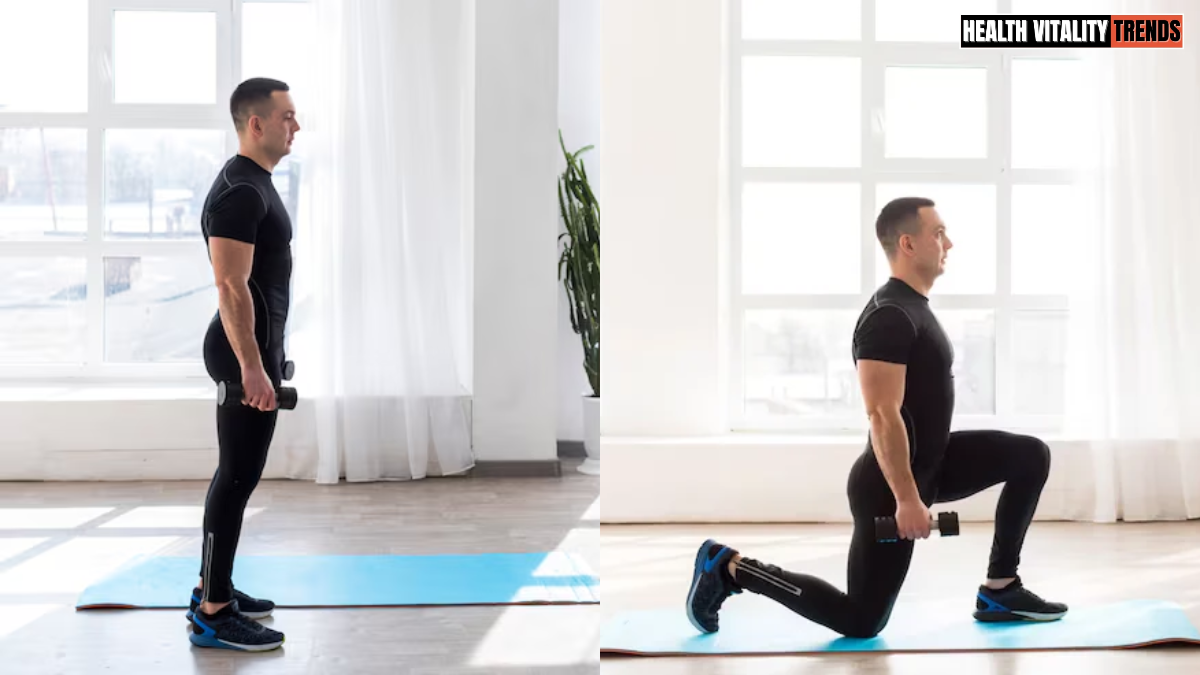
Imagine you’re holding a pair of dumbbells and beginning your walking lunges. You step forward with your right leg, lower your body until your left knee approaches the floor, and prepare to push yourself upward.
Everything looks fine initially.
But as you lower your body, you begin leaning your upper body excessively forward. Instead of maintaining control through your hips and trunk, you allow your torso to collapse forward, sometimes rounding your lower back in the process.
And this is where your technique needs attention.
When you lean forward, your body’s center of mass moves relative to your hips and knees. This changes the external forces and muscular demands involved in controlling the movement.

Your spinal erector muscles, which help stabilize and extend your spine, may have to work harder to control your trunk. If you lose your spinal position or use momentum to get back up, you can also make the movement unnecessarily demanding on your lower back.
But here’s an important scientific distinction: leaning your torso forward does not automatically switch the workload from your glutes to your lower back.
In fact, research published in the International Journal of Exercise Science in 2021 examined different trunk positions during lunges. Researchers found that forward trunk inclination increased lower-lumbar erector spinae activity, but it also increased hip-extensor demands in relevant lunge conditions.
In other words, a controlled forward lean can actually increase gluteus maximus involvement. The problem is not every degree of forward inclination. It’s losing control of your trunk, allowing excessive spinal movement, and using a position you cannot comfortably stabilize.
This distinction matters because I don’t want you to walk away thinking that an absolutely vertical torso is the only correct way to perform lunges.
Your objective should be to maintain a controlled trunk position, not force your body into an unnatural posture.
How to Perform Walking Lunges Without Losing Control of Your Glutes
If I were correcting someone’s walking lunge technique in the gym, these are the things I would focus on first.
1. Start with a comfortable step length.
Hold a dumbbell in each hand and stand upright with your feet approximately hip-width apart. Step forward with one leg, choosing a stride length that allows you to lower your body comfortably without losing balance.
Avoid taking an unnecessarily short step or an exaggeratedly long one. Your stride should allow your front foot to remain stable while your back knee moves toward the floor.
2. Control your upper-body position.
As you lower yourself, maintain a stable trunk and a comfortable spinal position. You can have a slight forward inclination from your hips, particularly if you want to emphasize hip-extensor involvement.
What you should avoid is rounding your lower back, collapsing your chest, or allowing your torso to fall forward uncontrollably.
Think of keeping your trunk strong and controlled throughout the repetition.

3. Lower yourself under control.
Bend both knees and lower your body until your rear knee approaches the floor. You don’t have to touch the floor with your knee. Your range of motion should depend on your mobility, comfort, and ability to maintain control.
Keep your front foot planted and avoid allowing your knee to collapse inward.
4. Push through your front foot to rise.
This is where your quadriceps and glutes work together to raise your body. Push against the floor through your entire front foot, including your heel and forefoot, rather than deliberately lifting your toes or shifting all your weight backward.
Extend your front hip and knee while maintaining pelvic and trunk control.
5. Complete the next step without rushing.
Once you regain a stable standing position, bring your rear leg forward and repeat the movement on the opposite side.
Don’t sacrifice balance just to complete more repetitions. A controlled walking lunge is far more valuable than a heavy, rushed repetition performed with poor mechanics.
🟧 READ MORE
- This Quick, Full-Body Yoga Flow Is Specifically Designed To Upgrade Your Daily Balance And Mobility
- 10 Yoga Poses to Add to Your Warm-Up for Better Lunges and Squats
Why Warming Up Your Glutes Before Lunges Can Help
There’s another recommendation I regularly make before lower-body training. Prepare your glutes before asking them to handle demanding exercises.
Your glutes aren’t responsible for every lower-body movement, and your lower back doesn’t automatically compensate whenever your glutes haven’t been warmed up. Your quadriceps, hamstrings, calves, and several other muscles have their own important responsibilities.
However, your glutes play a significant role in hip extension, pelvic control, and lower-body stability. Preparing these muscles through appropriate movement can help you rehearse the movements you’re about to perform.
I particularly like these three bodyweight exercises.
1. Bodyweight glute bridges
Lie on your back with your knees bent and feet flat on the floor. Push through your feet and raise your hips until your shoulders, hips, and knees form an approximately straight line. Squeeze your glutes briefly at the top without excessively arching your lower back. Perform 12 to 15 controlled repetitions.
2. Single-leg Romanian deadlifts
Stand on one leg while keeping a slight bend in your supporting knee. Push your hips backward and extend your free leg behind you as your torso inclines forward. Maintain a stable spine and return to standing by extending your hip. Perform 8 – 10 repetitions per side, using a wall for balance if necessary.
3. Donkey kicks
Get on your hands and knees with your spine in a comfortable neutral position. Keeping one knee bent, raise that leg behind you by extending your hip. Avoid rotating your pelvis or arching your lower back to gain additional height. Perform 10 to 12 repetitions on each side.
These movements provide a low-load opportunity to practice hip extension and pelvic control before your main workout.
One Important Point
Glute activation exercises aren’t a magical requirement for muscle recruitment. Your glutes will work during lunges even without completing a separate activation routine. Think of these exercises as preparation, not a way to switch on muscles that would otherwise remain inactive.
Research on gluteal activation warm-ups has also produced mixed results. A study involving professional rugby players found that a glute-focused warm-up did not consistently increase estimated gluteal force production during the subsequent exercise.
The practical takeaway? Warm up intelligently, avoid unnecessary fatigue, and prioritize the quality of your actual working sets.
🟧 READ MORE
- I’m a Personal Trainer — Here’s Why Yoga Can Be Useful Even if You Already Lift Weights
- 4 Functional Fitness Exercises That Support Healthy Movement For Life
Don’t Confuse Muscle Activation With Muscle Growth
Here’s something I want you to remember as you progress with walking lunges.
Feeling your glutes working doesn’t automatically mean you’re building more muscle. Muscle growth depends on several factors, including progressive resistance, sufficient training volume, appropriate effort, nutrition, and recovery.
A 2025 study examining forward lunges found that step length and the inclusion of a forward stride influenced the activity of several lower-body muscles. Longer steps generally increased activity in the gluteus maximus and other lower-body muscles, while lunges performed with a stride also increased gluteal activity compared with stationary variations.
This supports an important training principle: small changes in exercise execution can influence how your muscles contribute to a movement.
But don’t interpret muscle activity measurements as direct proof of greater long-term muscle growth. EMG studies measure electrical activity, not actual hypertrophy.
My recommendation is to start with a manageable dumbbell weight, perform 8 to 12 controlled repetitions per leg, and gradually increase resistance as your technique and strength improve.
And if you notice that one leg consistently feels less stable or struggles to complete the same repetitions, don’t ignore it. Reduce the weight, work on that side’s control, and gradually build up.
If you enjoy practical gym lessons, exercise corrections, and personal-training insights like these, follow our Facebook page. I regularly share fitness guidance to help you understand not just which exercises to perform, but how to perform them correctly.

The Bottom Line: Stop Blaming Your Glutes for Poor Lunge Mechanics
Walking lunges are among my recommended unilateral exercises because they challenge your quadriceps, glutes, balance, and coordination simultaneously.
But simply holding heavy dumbbells and walking forward doesn’t guarantee effective training.
Your body needs to maintain control throughout the entire movement. Pay attention to your stride length, trunk position, knee alignment, and ability to push yourself upward without losing balance.
And remember, a slight forward torso inclination isn’t necessarily a mistake. What matters is maintaining a stable spine and controlling the movement rather than allowing your lower back to take over unnecessarily.
Prepare your lower body with a sensible warm-up, choose a weight you can manage, and focus on performing every repetition properly.
You don’t need to make lunges unnecessarily complicated. You just need to understand what your body is doing.
Want more practical fitness and training advice? Join our WhatsApp community for short daily fitness tips, exercise guidance, strength-training advice, and useful insights to help you train smarter and build a stronger body.
Editor’s Note: This content is for informational and educational purposes only and is not intended to diagnose, treat, or cure any medical condition. Always consult your physician or a qualified personal trainer before starting any workout or nutrition program.