Swap Your Heavy Squats for This Single Step-Up Variation to Transform Your Stability
Why Your Standard Leg Routine Is Missing This One Crucial Element
When beginners join the gym as novice lifters, their leg day usually follows a familiar lower-body exercises — Squats, Leg extensions, Lunges, Leg curls, Calf raises, and Leg presses. These are the foundational exercises that help in developing lower-body strength, muscle size, and overall athletic performance.
But there is one important element that often gets overlooked, which is — The single-leg strength and stability.
Let me explain why!
You might be able to squat a heavy barbell without difficulty, but can you maintain the same control when standing on one leg? More importantly, does your left leg produce the same strength and stability as your right?
These differences can go unnoticed for years. When one leg consistently compensates for the other, you may develop strength and muscle-size asymmetries, reduced lower-limb control, and limitations in everyday movements such as climbing stairs, walking uphill, or running.
This is why I recommend incorporating unilateral leg training at least once a week. Instead of allowing your stronger leg to compensate for your weaker side, you give each leg an opportunity to work independently.

My honest recommendation? The High-Box Step-Up.
Unlike conventional bilateral exercises, this variation challenges one leg at a time while demanding coordination, balance, and controlled movement throughout the repetition.
🟧 READ MORE
- No Mat? No Problem. Use a Blank Wall for These 5 Deep Flexibility Poses
- A Sports Dietitian Explains Who May Benefit Most From Creatine
How to Master the Deceleration-Focused High-Box Step-Up (Step-by-Step)
The High-box step-up looks simple, but the real challenge is in controlling your body throughout the entire movement. You’re not just stepping onto a platform. You’re asking one leg to generate enough force to lift your body while maintaining balance and controlling the descent.
For beginners, I recommend starting with your body weight alone. Forget the dumbbells for now. Master the bodyweight movement first.
Equipment needed:
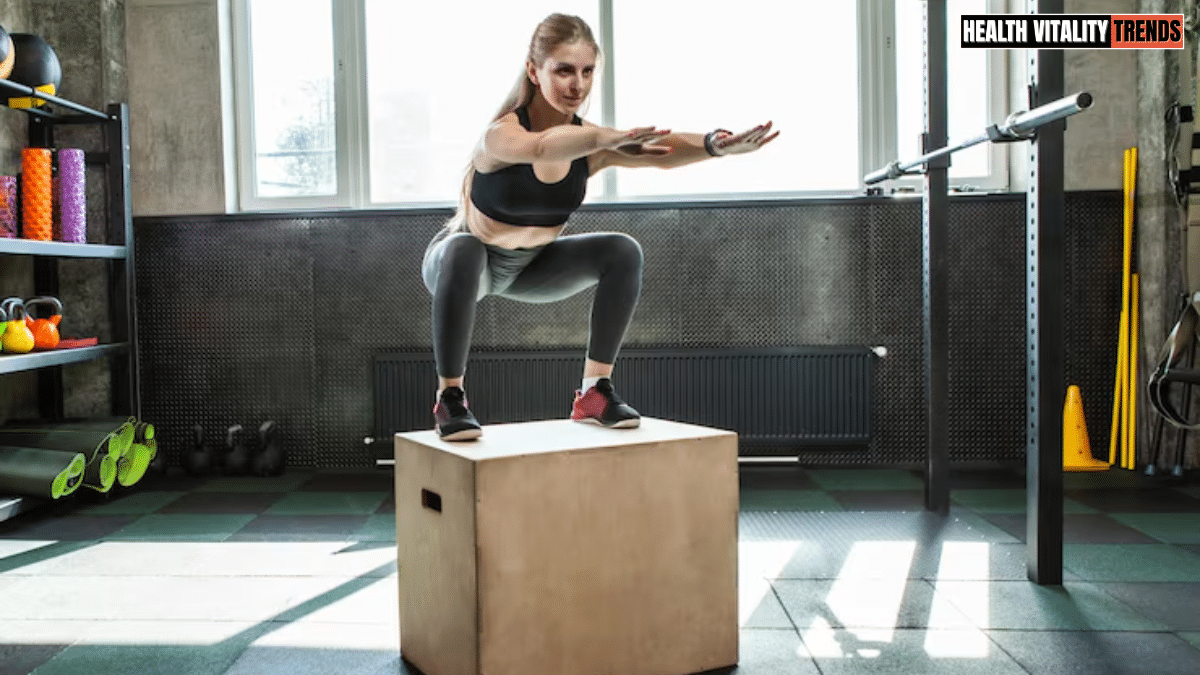
A sturdy wooden plyometric box or elevated exercise platform that does not slide or wobble. Choose a height that challenges your hip and knee mobility without forcing you to round your back, lose balance, or push excessively through your trailing foot.
How to perform it:
1. Set your starting position:
Stand facing the box with your feet approximately hip-width apart. Keep your torso upright and your core engaged.
2. Place your working foot:
Lift one foot and place it completely on the elevated platform. Your entire foot should be supported, including your heel.
3. Drive yourself upward:
Push through the foot on the box, extending your hip and knee to raise your body. Avoid using your trailing leg to push off the floor.
4. Reach the standing position:
Bring your other foot onto the platform and stand tall. Keep your movements controlled rather than rushing through the repetition.
5. Control the descent:
This is where the exercise becomes particularly valuable. Slowly step backward with your non-working leg, lowering your body over approximately 2 to 3 seconds. Keep the working knee aligned with your toes and avoid dropping suddenly.
6. Complete your repetitions:
Return to the starting position and repeat using the same working leg before switching sides.
My training recommendation:
- For Beginners: 5 controlled repetitions per leg.
- For Intermediate and Advanced trainees: 10 or more repetitions per leg, provided they can maintain proper technique.
- Start with body weight: Introduce dumbbells or barbells only when your balance and movement control are consistent.
Pay particular attention to the lowering phase, also called the eccentric phase. “Your muscles must control your body against gravity rather than simply allowing you to drop back to the floor”.
And that’s the difference between simply climbing onto a box and deliberately training single-leg stability.
Want more practical exercises and trainer-guided strength advice? Follow our Facebook page for daily fitness inspiration, mobility drills, and workout ideas you can incorporate into your routine.
🟧 READ MORE
- The Simple Balance Test That Reveals Why Your Stride Is Imbalanced
- You Might Be Eating Enough Protein — But Still Missing This Key Nutrient
The Science of Unilateral Strength: Why High Step-Ups Outperform Traditional Lifts
The biggest advantage of the high-box step-up is that it makes each leg work independently.
During conventional squats and leg presses, both legs contribute to moving the load. But one leg can sometimes compensate for the other without you noticing. Unilateral exercises help address this by allowing you to train each side separately.
And the high-box step-up brings several important benefits together:
1. Develops genuine single-leg stability
When one foot supports your body during the upward and downward phases, your muscles must coordinate to maintain balance. Your glutes, particularly the gluteus medius, help stabilize your pelvis and control unwanted movement.
2. Encourages more balanced leg development
Each leg receives its own workload. You can identify differences in strength, coordination, and movement control instead of allowing your dominant side to do most of the work.
3. Recruits multiple lower-body muscle groups
The movement involves several major muscle groups:
- Quadriceps: Extend your knee to drive your body upward.
- Glutes: Extend your hip and help stabilize your pelvis.
- Hamstrings: Assist with hip extension and control movement.
- Calves: Contribute to ankle control and stability throughout the exercise.
Research published in the Journal of Strength and Conditioning Research examined step-up variations and found substantial activation of the gluteus maximus, gluteus medius, and hamstring muscles during the movement.
As a personal trainer, I consider the high-box step-up one of the most useful unilateral exercises for developing lower-body coordination, strength, and stability. No single exercise can replace every benefit of squats, but this variation offers a combination of single-leg strength and controlled mobility that conventional bilateral lifts may not adequately challenge.
If you want to introduce more variety into your leg training, you can also rotate these four unilateral exercises into your weekly routine:
- Single-Leg Leg Press: Helps develop individual leg strength with machine support. – Check Exercise Here
- Bulgarian Split Squats: Challenge quadriceps, glutes, balance, and hip stability. – Check Exercise Here
- Single-Leg Romanian Deadlifts: Develop posterior-chain strength while challenging balance and hip control. – Check Exercise Here
- Single-Leg Glute Bridges: Target the glutes while allowing each side to work independently. – Check Exercise Here
The goal isn’t to abandon traditional leg exercises. It’s to stop overlooking what each leg can accomplish independently.
For more short daily fitness tips, strength-training advice, and practical workout guidance, join the Health Vitality Trends WhatsApp Community. Make every training session count!
Editor’s Note: This content is for informational and educational purposes only and is not intended to diagnose, treat, or cure any medical condition. Always consult your physician or a qualified personal trainer before starting any workout or nutrition program.