Why Your Chest Isn’t Growing (Even Though You Bench Every Week)
Let’s get this straight! There is one muscle group besides the arms that most individuals love to train is the chest. I know it for sure; Arms, Shoulders, and Chest are the favorite group to train for anyone who wants a bigger aesthetic frame.
But wait a minute! Do you know your chest muscles are more prone to not get trained properly?
Yes! You could show up at gym everyday, load but the barbell or pick up the heaviest dumbbell for the chest press. And finish your chest workout with flyes or bodyweight push-ups.
Yeah, all that we want is to have that sick chest pump and flex in the mirror.
But wait! It has been weeks or months, and now you have begun to notice that your chest hasn’t grown even an inch. I don’t know if you have ever experienced it, but as a certified personal trainer who has coached several beginners and intermediate lifters, I can tell you this is one of the most common complaints in the gym.
Yeah! Most of the newbies think, more weight or repetitions on the chest press automatically equals to a bigger chest. Well tell you what, it doesn’t.
If your chest isn’t growing, it’s usually not about the effort. It’s about execution.
Let’s get straight to it.
Editor’s Note: This content is for informational and educational purposes only and is not intended to diagnose, treat, or cure any medical condition. Always consult your physician or a qualified personal trainer before starting any workout or nutrition program.
5 Reasons Your Chest Isn’t Growing (And How to Fix Them)
1. You’re Not Progressively Overloading
You have been consistent with your workout and have been regular to the gym for months. You even crush your chest exercise with the same weights and repetitions, and still it refuses to grow. You see any pattern here?
According to an article published by PubMed Central, a muscle won’t grow unless it is forced to adapt to a progressive overload. Which means that if your goal is to increase size or strength in any of your muscle groups, you need to increase these in your workout plan: Weight, Repetitions, Sets, Time under tension or Overall training volume.
Solution: Keep a chart or sheet to track your last DB chest press record. Now, the goal is to increase poundage slightly (not too much), which DB your chest press.
For example, if you are stuck with a 40-pound dumbbell chest press for 15 reps, it becomes your muscle-maintenance weight. So to shock the muscle, you should force your pectoral muscles to adapt to do at least 10 to 12 repetitions with a 45 pound dumbbells. This is what it takes to grow new muscles.
[Also See: Calisthenics Exercises That Build Real Strength And Endurance]
2. You’ve Hit a Plateau (But Haven’t Changed Anything)
In the muscle building encyclopedia, the word Plateau means your muscle building growth has come to a halt, as the muscle has become used to all the tactics that you are currently doing for muscle hypertrophy or strength building.
Let’s understand it with an example: You have been doing bench press for weeks, without even bothering to increase the reps or poundage. This is what will eventually halt your progress, as your pec muscles have become used to it. To say simply, they are bored.
Solution: Change your chest press exercise. Instead of doing bench press, try a plate-loaded chest press machine or an incline angled chest press. This new exercise motion will feel fresh to your pectoral muscle, and thus it will respond with possibly better results. Additionally, you can tryout different rep ranges (for strength and hypertrophy).

3. Your Form Is Limiting Chest Activation
This one is huge.
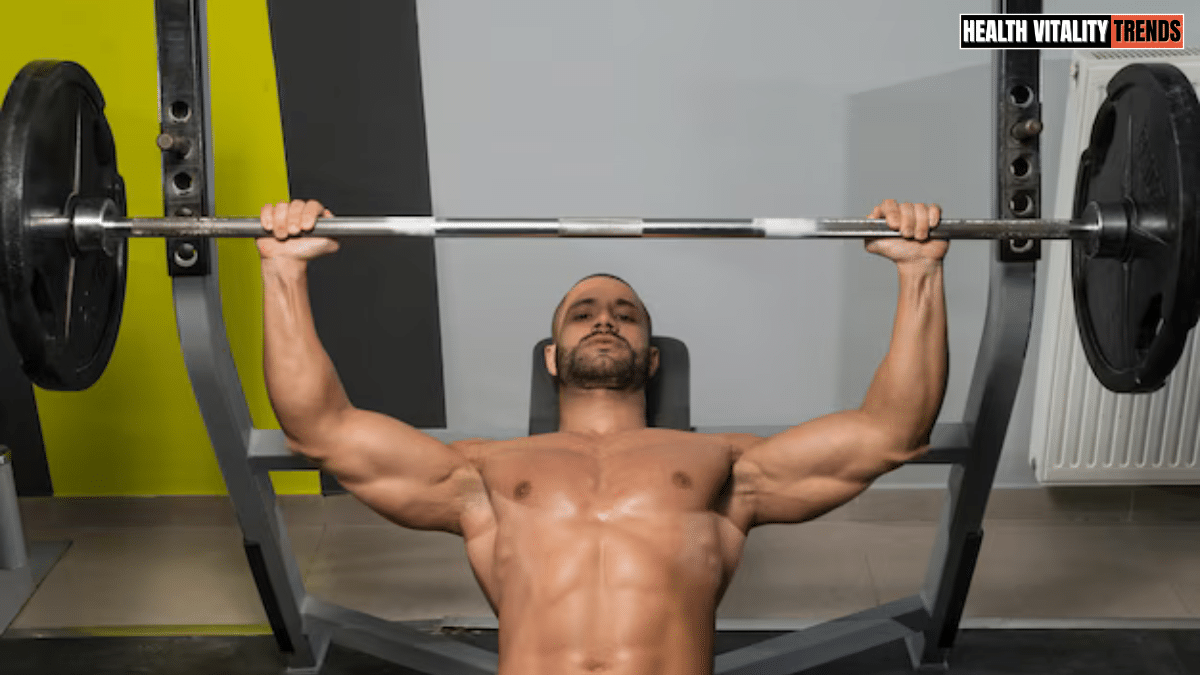
As a trainer, I have seen many lifters who have the capability to 80-pound chest press, but you know what, they still do not have the right pectoral muscle growth, because they are doing the whole exercise wrong by overusing their shoulders and triceps muscles.
Common mistakes when doing a Chest Press are:
- Elbows are either too wide or too narrow.
- Doing partial reps that do not stretch the pec muscle properly in the eccentric phase.
- Bouncing the bar off the chest.
- Bending your wrist backward, with barbell in your hand.
- Rushing down during the lowering phase.
Solution: Chest press is a compound exercise that uses different muscle groups at a time to execute a pressing movement. Thus, it requires you to follow a strict exercise form and techniques, which are:
- Always execute pressing movements with a full range of motion.
- Control the barbell or dumbbell at negative (lowering) phase.
- Use wrist bands to avoid bending your wrist.
- Focus on squeezing the chest at the top.
- Wear a weight-lifting belt to maintain strict body posture.
Another important point is to do the chest press movement with a lighter weight. If you are experiencing that you are doing the exercise with an incorrect form. A better solution is to hire a certified personal trainer, who can explain and show you how to do the exercise in the correct from practically.
4. You’re Not Eating for Growth
Many times, a person might break his PR, achieve a new record on this chest press, and still have poor pectoral development. And the primary reason is that, they are not eating right.
It means, you can train perfectly and still not grow at the same time, because you are not taking the right nutrition that will support your muscle building goals.
Understand that your muscles needs a calculated amount of protein nutrients to grow, and the portion differs from person to person. Hence, if your protein intake is low, and you are constantly in a calorie deficit, your body won’t prioritize building any muscles.
Solution: As a trainer is important to guide you to do a certain exercise in the correct form. Similarly, you need a fitness nutritionist too, who can design you a nutrition plan for your muscle building goal. A common muscle-building nutrition plan includes:
- Aiming for around .7 to 1 gram of protein for per pound of body weight.
- Make sure you are not in a calorie deficit.
- Spread your daily protein intake across 3 to 5 meals in a day.

[Also See: How To Do Barbell Curls? Muscle Worked, Common Mistakes and Best Alternatives]
5. You’re Overtraining Your Chest
Yes, this is real, and many of us won’t even notice it at first hand.
Think like this – You do chest on Monday, then again on Wednesday, and again some few sets by the end of the week, just because you like to train it every much. Now, you can calculate for yourself how many sets you have already done for the pectoral muscle in a week, without even letting the muscle rest.
That’s right, in the case of muscle building, more is not always better.
If your chest is constantly sore, and you begin to notice that your performance is dropping, you might need to cut down the training day and let the muscle recover properly.
Solution: Remember this, your muscles grow during recovery, and not during the workout. And even if you skip 2 or 3 gym sessions for recovery, you do not lose any muscle mass or strength. Instead, you come back stronger than before as your muscles have properly recovered.
Trainer’s Tips:
- Train chest not more than twice a week.
- Minimize overtraining in a single gym session by doing a quality workout.
- Sleep 7 to 8 hours.
- Take rest days seriously.