Why the Triceps Pushdown Is Still One of the Best Arm Builders in the Gym
As a certified personal trainer, if someone tells me they want bigger arms, the first thing I usually ask them is how much attention they’re giving to their triceps.
Believe it or not, most people immediately think about biceps when they want to build their arms. But from my experience, it is the triceps that actually make up the majority (2/3 rd) part of the upper arm. If you want arms that look thicker and more developed, your triceps training needs to be solid.
Over the years, I’ve seen lifters new or old, experiment with all kinds of exercises for the triceps, like skull crushers, overhead extensions, dips, close-grip presses, and various machine movements.
But one exercise that has remained consistently popular in almost every gym for building triceps is the triceps pushdown.
No matter how much you train your arms with any advanced equipment, this simple cable movement still continues to be one of the most reliable ways to train the triceps. And there are a few good reasons why I still recommend it to both beginners and experienced lifters.
Editor’s Note: This content is for informational and educational purposes only and is not intended to diagnose, treat, or cure any medical condition. Always consult your physician or a qualified personal trainer before starting any workout or nutrition program

[Also See: Why Your Chest Isn’t Growing (Even Though You Bench Every Week)]
1. It Keeps Constant Tension on the Triceps
One of the biggest advantages of the cable pushdown is the constant tension it provides to the triceps muscle during the exercise.
In a free-weigth exercises (barbell/dumbbell), the resistance or tension on the muscle slightly keeps changing constantly because the angle of the lift also changes under the gravity. That is why you may feel that the movement has become easier at some part of the range of motion.
But in a cable-based exercise, things work differently. During a cable pushdown, the cable continues to pull against your arm until the exercise is complete. So, from the moment you pull the bar or rope down and extend your arm to the point where your elbows are fully straight, the triceps stay under tension.
And from a muscle-building perspective, this is what is required to grow muscles. Keeping the muscle working through the full range of motion helps create a strong contraction and better overall fatigue by the end of the set.
2. It’s One of the Most Joint-Friendly Triceps Exercises
Another reason to include cable pushdowns in an arm workout plan is because it is one of the most joint friendly exercise out of all the tricep exercises.
Exercises like Skull Crusher, Dumbbell Extension or Single Arm Dumbbell Extension can place a lot of stress on the elbows, especially when heavy weights are involved. Movements like skull crushers or heavy tricep dips can sometimes bother lifters who already have sensitive elbow joints.
Therefore, Pushdowns are usually much more comfortable, because the resistance comes from a cable stack, and the movement feels smoother and easier to control. Lifters can also adjust the weight quickly to find a resistance that challenges the muscles without putting any unnecessary strain on the elbows.
3. The Movement Is Simple to Learn
As a coach, I always appreciate exercises that people can learn quickly without complicated techniques. Some exercises require a lot of practice to perform correctly. Squats, deadlifts, and Olympic lifts are great exercises, but beginners often need time and practice sessions to build proper form before they see any results from the exercise.
The Tricep Pushdown is an isolation exercise and is a very straightforward exercise:
- Grab the bar/rope
- Keep your elbows close to your sides
- Extend your forearms downwards till your elbows are straight
- Control the weight as you return to the starting position.
Because the movement is very simple, most lifters can feel their triceps lateral head working almost immediately. This makes it a great exercise for beginners, while still being performed by experienced lifters who want to isolate the triceps after heavier pressing exercises.
[Also See: Stop Wasting Leg Day: The Squat Mistake That’s Killing Your Gains]
4. It’s Easy to Progress Over Time
In weight lifting, progressive overload is the definite key for building muscles. Thus, the muscles need to be challenged gradually with more resistance, more repetitions, or more overall training volume.
And in the case of pushdown exercise, it is very easy to progressively overload with the cable stack.
The cable stacks allow you to increase weight in small and manageable increments. You can also adjust your reps, slow down the tempo, or add extra sets to make the exercise more challenging as your strength improves.
Straight Bar vs Rope Pushdown
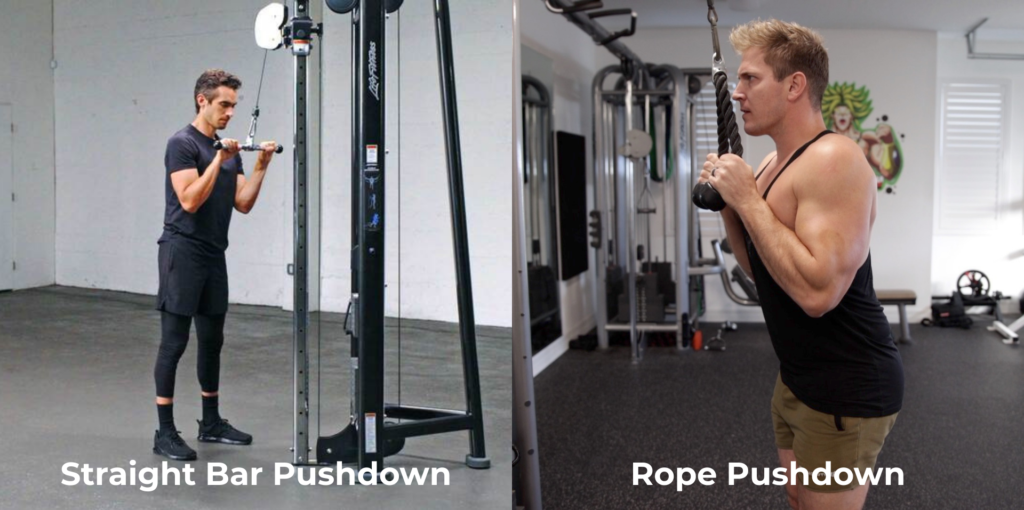
In most gyms, you’ll see two common versions of the tricep pushdown.
The straight bar pushdown is the classic variation that allows for a strong grip and often makes it easier to use with heavier weights.
The rope pushdown is another popular option. The rope attachment allows your hands to move more freely and separate slightly at the bottom of the movement. Often, lifters choose the rope more than the straight bar pushdown as they find this version more comfortable for their wrists and elbows.
Both variations are effective, and in most cases it simply comes down to which one feels better for you.
[Also See: The One Dumbbell Move That Fires Up Your Entire Upper Body (Most Lifters Ignore It)]
Why I Still Recommend Pushdown For Building Big Triceps
Exercise and fitness trends change all the time. New machines are appearing more than ever in the gym, training styles are also evolving, and people are constantly looking for the next “best” exercise. But some movements stay popular because they simply work.
The triceps pushdown is one of those exercises. All because it is easy to set up, fast to learn, joint-friendly, and very effective at isolating the triceps.
And after all these years of coaching people in the gym, it’s still one of the best exercises I have seen delivering consistent results for building stronger and more defined arms. And that’s exactly why it continues to show up in so many arm workouts.